

East Fork is currently hosting a raffle for Asheville Writers in the Schools and Community. Purchase a ticket here to enter for a chance to win four 3-piece dinner sets in the color of your choice from our color library. Raffle ends Tuesday, November 29th at midnight PST.
“I am because you are.”
We sat down with some of AWITSC’s team to talk about healing our inner child, celebrating ancestral connection, leaning into abundance, and the power of being led BY youth FOR youth:
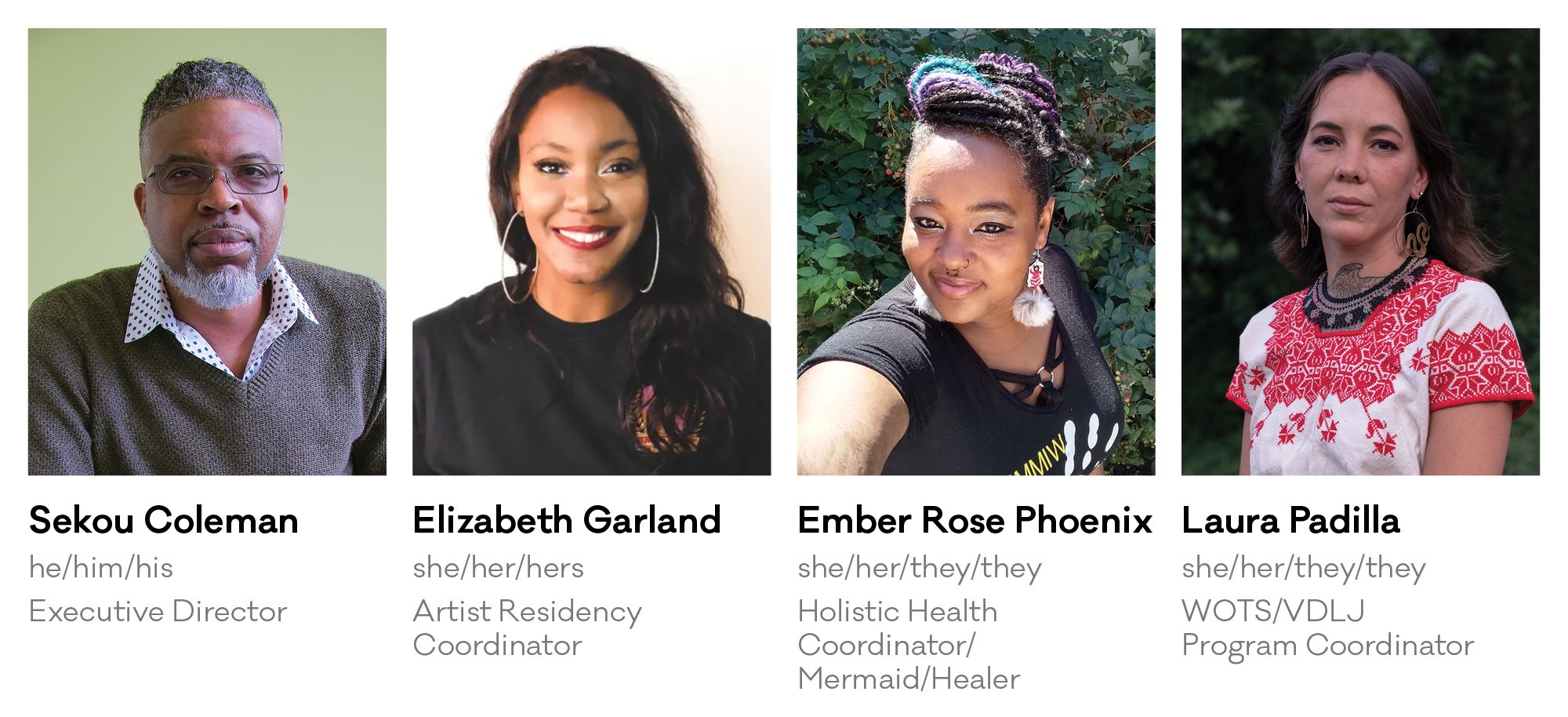
This interview has been edited for length.
Read the first half of this interview here.
Can you tell me more about the program initiatives (a teaching artist residency program and Word On The Street/Voz De Les Jóvenes) under the umbrella of Asheville Writers In The Schools and The Community?
Laura Padilla: Word On The Street/Voz De Les Jóvenes (WOTS/VDLJ) is an afterschool paid internship and bilingual arts program for BIPOC youth in Asheville, we host about 16 teens from different schools and communities. Through art and under the lens of restorative justice and self expression, our youth (the squad) come to explore various art mediums according to their own interest.
We work closely with local artists that have gone through our teaching artist residency to then pair them with squad members in individual or group projects. Artist mentors help the squad build their skills and knowledge while also preparing them for exhibitions and teaching them how to market their work and generate income from it.
We also host a series of workshops once a month that are solely focused on healing, these open the space for our teens to have an exclusive space with their peers to talk about any issues that directly impact them and their communities: Black healing circle, Latine healing circle and a Queer healing circle.
In addition to this, Word on the Street/Voz de les Jóvenes hosts an intensive summer institute, an overnight summer retreat, and field trips (theater, museums, exhibitions, conferences, nature; etc).
Elizabeth Garland: As an artist resident coordinator, I collaborate with our host sites: The Grant Center, YTL, Eddington Center, Shiloh. We've worked with multiple different community centers along with youth organizations. What I get to do is really highlight and see the talented individuals that we have in our Asheville community and then hire them for their talents and place them in host sites where they can share that with youth.
For example, StoryCraft is a collaboration that we've had with Blue Ridge Public Radio since 2021 where we are highlighting the stories from the youth BY the youth, and also allowing space for learning camera work. So not only just written stories, but also audio recording those stories and capturing things through a camera, through their eyes.
Could you share a story of when you knew your work was impactful, something you're proud of, maybe even just a moment that you wanted to pause and celebrate?
Sekou Coleman: I think for me, one story where I knew this work was impactful, comes from the beginning of my relationship with this organization. And it was with some young people who have aged out of our program now. This was at a meeting for the Buncombe County commissioners. They were having public comments in relation to establishing a new funding opportunity for organizations working in marginalized neighborhoods around Asheville and Buncombe County.
During public comment, people were coming in to talk about why the commissioners needed to be doing this. And some young people from Word on The Street had been invited to create a community documentary. They interviewed some local activists and community residents from various neighborhoods like Shiloh and Burton Street. They got a chance to tour the places and get a deeper understanding of the harm that was done through practices like redlining and urban renewal.
They showed their documentary and addressed the county commissioners and one of them says, I'm paraphrasing, but essentially he says, "Y'all just need to go ahead and give the communities this money. You know you got it from all these hotels that keep going up every other day."
And of course everybody laughs and it was said with a reverence that only a teen from these communities would have for county commissions. “I don't know y'all but you're going to hear my truth right here, right now.” The commissioners voted and unanimously passed the funding resolution.
That's a story of when I just knew at that point, that was the way to really help get these messages across. I saw the impact on how the community responded, but most importantly, I saw the impact on the young people and the fact that they felt held enough to share their authenticity in this space that others might find intimidating.
Ember Rose Phoenix: I think it's twofold for me. I interviewed for this job in February of 2022, and one of my caveats after interviewing with Sekou was that I didn't feel comfortable taking the job until the squad (what we call our youth) and the rest of the staff said yes. Because as a healer, culturally, I don't get to self claim that. It's what the community needs and providing that is a gift or a service, but I can't just walk into some community and be like, "You need healing."
I can offer them services, but they have to want it. For me, just going to the interview with the squad and having them ask me some really random but also some really beautiful questions and hear them talking and being like, "Yeah, no, we definitely want you here. You'll be a good fit. We need healing."
Then having people tell me, "I had no clue what the heck you were supposed to be doing, but I didn't know I needed any of these things until you showed up. And now I recognize that there's places where I can thrive and where I can heal and where I actually have the ability to access some of these things."
I think for a lot of us in general on the fringes and who are marginalized, I truly believe we all came here with everything we needed. It's just about re-remembering and letting go of some of that hurt and the trauma that life has caused us and our ancestors to be able to identify and really get intentional with our own intuition to be able to claim it and name it and speak it.
Watching that happen, especially with this next generation, and moving the fuck out of the way so that they can blaze nice and bright is really how I know that this is where I'm supposed to be and the work is called right here. Because it's not about me, it's about them. In the moment, I can move into the shadows and watch them shine. I know that it's worth every damn bit of anything to get there.
Elizabeth Garland: It was 2017/2018 and I was co-facilitating a podcast production workshop for the squad of Word on the Street. These kids, the squad, were talking about the titles of their podcasts: one was “Opinionated Voices,” another one was “Be Like Water,” where you have to be flexible and learn from each other, to see them at such a young age beginning to form these big ideas, I realized that they need me as much as I need them.
One of my favorite moments, in 2019, one of the squad members said to me, "You're a teenage translator." And I was like, "What do you mean, I'm a teenage translator?" I realized it meant that I'm able to communicate with the adults while making space for what our teenagers are thinking to bring them into the conversation and advocate for them in these spaces.
I hold onto that as such a huge responsibility that I want to be able to interpret for any age no matter what, because we all have a voice and we all need to be heard. I just thought that was such a huge badge of honor.
Sekou Coleman: One final thing, the intergenerational aspect is on full display in this one example that I can follow up with. One of the participants that Liz was talking about in podcasting is now a teenager that has, in addition to remaining with Word on the Street, been working as an assistant artist mentor with our StoryCraft project and with our Family Voices project. And recently, with support from Blue Ridge Public Radio, they just had a podcast episode that was on an NPR affiliate. That's the ripple of working with this little workshop at this one space, to actually have something that is published on an NPR affiliate, that's really impactful.
Can you describe some of your barriers in this work? I know you mentioned lack of funding, transportation, discrimination in the arts. Can you describe what you feel are some of the most impactful, some of the largest barriers you work with daily?
Sekou Coleman: I think barriers are really all about your mindset. What some folks might see as barriers, others might see as stepping stones because they push us to respond in ways that we need to. So we are often faced with different challenges.
Transportation is one of the things that we're working around. We're grateful for the support we got from the community, that will allow us to purchase a van, which is much needed for the work that we do in terms of being able to transport the young people to and from program activities. We're often needing additional volunteer support in ways. Sometimes it could just be an individual who might have the time to serve as a van driver to pick folks up.
And the location we were in before was a bit of a barrier but we've moved beyond it. That's kind of indicative of how we roll through things. We figure out, "Okay, well if this is a barrier, how do we navigate this barrier?"
Ember Rose Phoenix: The thing that I've identified since I've been working with AWITSC as our biggest challenge is really the fact that because we're not trying to fit into any type of mold, we're trying to smash down all of the nonsense and create something that feels really integral to the current iteration of the people that are showing up. We're not pandering for support, we're also not being performative.
We're just doing the work and in doing the work and putting all of our focus there, a barrier arises around support because we're not in a place of ego, we're in a place of interdependence. Having to take the time to step out of that and try to explain to people or ask for support versus just having people trust the community when they say there's a need is the biggest barrier because it tends to lend to this lens of needing to prove something when really the proof is in the relationships.
We deserve access to resources, wisdom, knowledge in our ancestral practices and our ancestral land without having to pander for it. We need a van. How easy it would be if we lived in a community that understood that the need superseded the why, to have one of these many organizations who have plenty of resources just be like, "Hey, you said you needed a van, we can write this off on our taxes. Here goes a van." Versus having to do fundraisers, which are great, but they take a lot of energy and resources away from what we're trying to do, which is to literally dedicate our time to building foundations. And that barrier is exhausting because all of us would much rather be creating the art, getting the land, being in the spaces and just doing the thing, not having to tap into other people to support it with resources or money.
Can you talk briefly about the events you have coming up in the next couple of months and what the goals are? What's the intention behind these activities?
Sekou Coleman: We talked earlier about cultivating this BIPOC arts and culture ecosystem, a significant component of that is having spaces where the arts and culture of BIPOC artists and communities is celebrated and reflected. We have three events taking place here in Asheville that offer us an opportunity to be the curators of such spaces.
On November 12th, 2022 we hosted our Fall Youth Arts Showcase. This model is something that's been a part of our programming pretty much since the beginning. Having a celebratory event that provides an opportunity for the young people participating in the program to share the work that they did with their peers, with the artists that worked with them, with their families, and with community members. This is the first time that we've actually done a sort of citywide youth celebration showcase.
We also on December 1st as part of our efforts to catalyze a more vibrant arts community. The event is a celebration of Latin cuisine and culture that we are calling Prendelo!
Ember Rose Phoenix:
We aren’t trying to invite folks to the table-we are changing the shape of the table by building it together in an inclusive way as a community, therefore we are asking members of our community who hold different levels of privilege and resource to purchase tickets that can be distributed to other members of community who otherwise may not be able to access our events.
Some ways you can show up as an ally to our community are by:
- Purchasing an extra ticket to be distributed to other community members
- Purchasing a ticket even if you cannot attend the event
- Donating money to be used to purchase tickets for other community members
- Sharing the event and suggesting other members of your family,communities, and friend groups also share and financially contribute to the event.
- Sponsoring a group of seats or a whole table for community members
Equity is about acknowledging privilege and removing barriers, community is about inclusivity and being interdependent. We look forward to building community with those who have values in alignment with ours.
Is there one aspect of your organization or your work that people would be surprised to know or to learn? And is there anything we haven't covered today you want to make sure we talk about?
Sekou Coleman: I want to highlight something that might not have been mentioned significantly today. There's a lot of harm that is caused in the community because the folks that we are connected with, those supporting us and those that we care about, aren't always doing their own internal work. I think that as an organization, even before I moved into a leadership role, it's always been an intentional focus to improve the way that we're moving internally so that the work that we're doing externally can be more impactful and better received.
We're not experts at it, we're broken and flawed humans just like the rest of them. But we're stepping into that and we're saying, "Hey, it's clear that these things that I'm bringing in are creating some kinds of issues. How can we deal with that so that we're not causing secondary unintentional harm because we are showing up in a way that's not allowing us to be our fullest self?"
We may not see the result of it in our lifetime in its full form. We may see little incremental steps here or there, but I'm very clear what I'm doing today is to benefit those who come along at my great grandchildren's level.
Founded in 2011 and committed to social justice and racial equity, Asheville Writers In The Schools and Community (AWITSC) provides youth and adults with opportunities to voice their experiences and their passions, through innovative arts and creative placemaking programs that engage more than 100 youth and their families each year.
They envision a just and equitable community where the artistic expression, cultural exchange, and voices of Black and brown people of all ages are amplified, celebrated, and published. They work to cultivate this vision through three program initiatives: a teaching artist residency program, Family Voices, and Word On The Street/Voz De Les Jóvenes (WOTS/VDLJ).


